
Security remains ECOWAS’s most urgent challenge. Extremist groups linked to al-Qaeda and the Islamic State continue to expand their operations across parts of Mali, Burkina Faso and Niger, threatening neighboring countries and displacing millions of people. In response, ECOWAS has intensified efforts to strengthen its peace and security architecture, improve intelligence sharing and accelerate the operationalization of its Standby Force to counter the growing threat of terrorism and organized crime.
Equally pressing is the bloc’s political future. Mali, Burkina Faso and Niger formally withdrew from ECOWAS after a series of military coups and subsequently formed the Alliance of Sahel States (AES), creating one of the most significant institutional challenges the organization has faced since its establishment in 1975. The departures have raised concerns about the future of regional integration and the effectiveness of ECOWAS as West Africa’s principal political and economic institution.
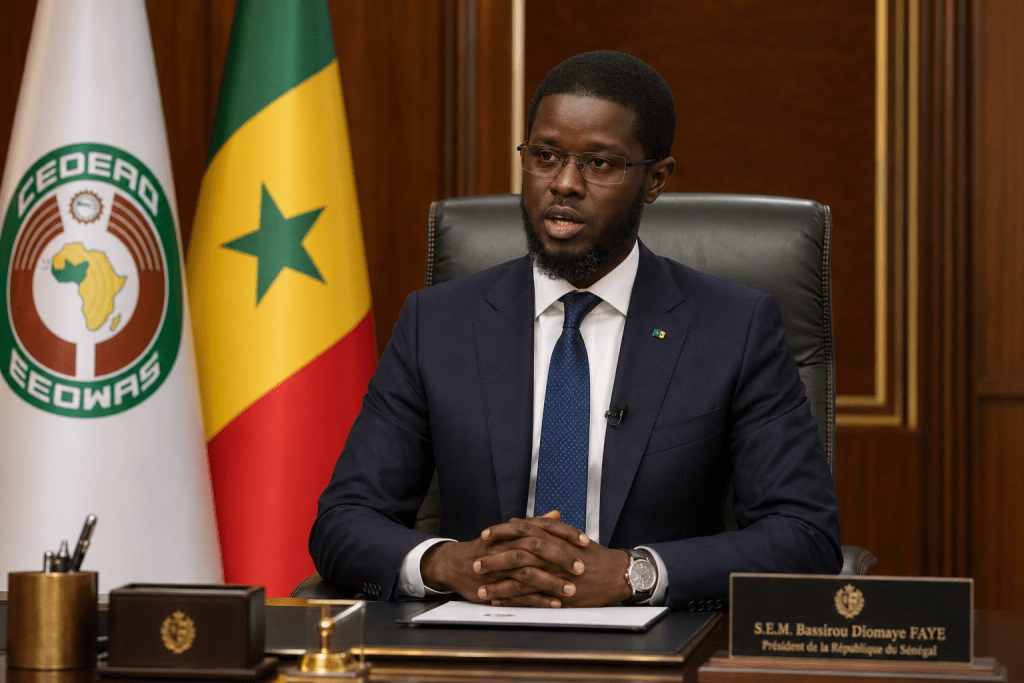
Throughout his presidency, Faye has advocated dialogue over confrontation in dealing with the breakaway Sahel nations. While reaffirming Senegal’s commitment to ECOWAS, he has consistently argued that rebuilding trust and maintaining communication with the AES countries will be essential to addressing shared challenges, including terrorism, climate change, migration and economic development. His diplomatic approach has positioned him as a potential bridge between ECOWAS and the military-led governments that have distanced themselves from the bloc.
Beyond security concerns, Faye’s leadership will also focus on strengthening regional trade, improving infrastructure connectivity and advancing the ECOWAS vision of greater economic integration. The regional bloc has long sought to facilitate the free movement of people, goods and capital across West Africa, but political instability and security crises have slowed progress toward deeper economic cooperation. Revitalizing those ambitions is expected to be a central priority during his tenure.
Analysts view Faye’s appointment as an opportunity to restore confidence in ECOWAS at a time when the organization faces questions about its relevance and unity. His reputation as a consensus builder and his emphasis on diplomacy could help ease tensions among member states while encouraging renewed engagement with countries that have distanced themselves from the regional body. At the same time, expectations remain high that ECOWAS will demonstrate stronger collective leadership in responding to the region’s evolving security challenges.
For West Africa, the significance of Faye’s election extends beyond a routine leadership transition. It represents an opportunity to reaffirm the value of regional cooperation at a time when shared security, economic resilience and political stability have become increasingly interconnected. Whether ECOWAS can emerge stronger under his leadership will depend on its ability to rebuild unity while adapting to a rapidly changing regional landscape.
