
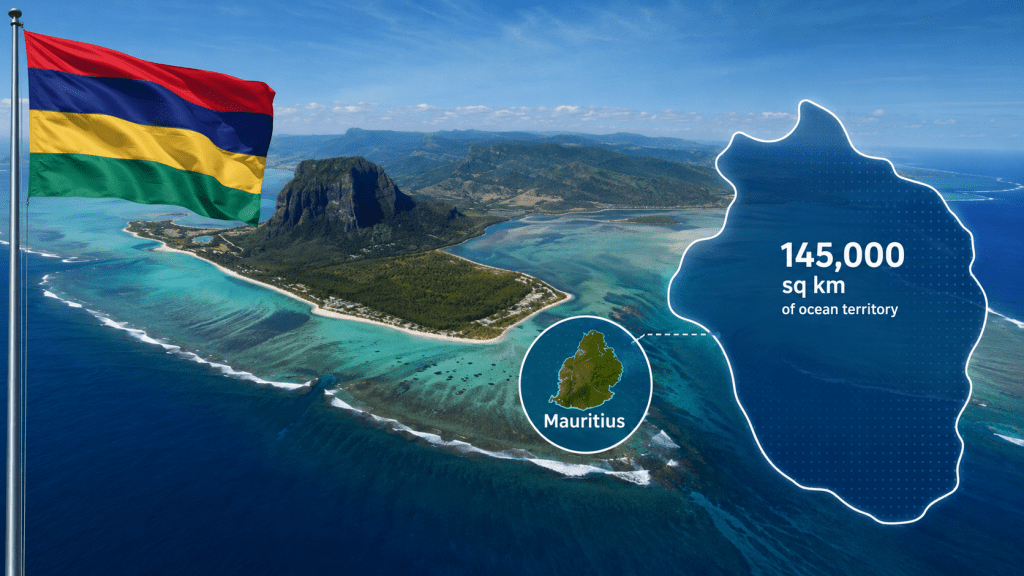
Mauritius had sought approximately 183,000 square kilometers in its 2024 submission. The commission ultimately approved more than 145,000 square kilometers after considering geological and oceanographic evidence showing that the country’s continental shelf naturally extends farther into the Indian Ocean.
For a small island state, the scale of the expansion is substantial. Mauritius has a relatively limited landmass, but its position in the Indian Ocean gives it access to a maritime area many times larger than its territory on land. The latest recognition further increases the economic importance of the ocean to the country’s long-term development.
Former Prime Minister Pravind Jugnauth, whose government submitted the proposal in July 2024, described the approval as an important milestone for Mauritius’s sovereignty and economic potential. The Mauritian Cabinet formally acknowledged the decision on August 14, calling it a major national achievement in the administration of the country’s maritime zones.
The breakthrough is the culmination of a process stretching back more than a decade. Mauritius first lodged a partial submission concerning its continental shelf in May 2009, demonstrating the lengthy scientific and diplomatic work often required for countries to establish rights over seabed areas beyond their standard maritime boundaries.
A New Blue Economy Opportunity
The economic potential beneath the newly recognized area could be considerable. The seabed is believed to contain polymetallic nodules — mineral formations that can hold cobalt, nickel, copper and rare earth elements. These resources have become increasingly valuable as governments and companies compete to secure materials needed for electric vehicles, renewable energy systems, batteries, electronics and other advanced technologies.
The opportunity arrives as critical minerals move closer to the center of global economic policy. Countries including the United States, China and India are seeking more secure supplies of the materials required for clean-energy technologies and advanced manufacturing, increasing the strategic value of previously overlooked mineral deposits beneath the world’s oceans.
For Mauritius, however, the expanded continental shelf offers possibilities beyond mining. Greater maritime rights could support fisheries, marine scientific research and renewable-energy development while strengthening the country’s broader blue-economy strategy.
That diversification could be particularly valuable for an economy already heavily connected to international trade, tourism and financial services. Developing additional ocean-based industries could create new sources of investment and expertise while giving Mauritius another avenue for long-term economic growth.
Any commercial exploitation of seabed minerals would nevertheless require careful environmental consideration. Mauritius has joined other African countries calling for a precautionary approach to deep-sea mining, reflecting wider concerns about the possible impact of extracting minerals from ecosystems that remain poorly understood. The challenge will be balancing the economic value of marine resources with the protection of the ocean environment.
The development also demonstrates how small island economies can possess strategic resources far beyond their physical land boundaries. As demand for critical minerals grows, maritime territory is increasingly becoming an important economic asset, particularly for countries located along major international shipping routes.
Strategic Importance in the Indian Ocean
Mauritius’s expanding maritime position comes amid renewed international attention on another part of its ocean territory: the Chagos Archipelago. Britain separated the islands from Mauritius in 1965, three years before Mauritius gained independence, beginning a sovereignty dispute that has lasted for decades.
The archipelago has exceptional strategic importance because Diego Garcia, its largest island, hosts a major United States-United Kingdom military facility. The base has played a significant role in American and British military operations because of its position between Africa, the Middle East and Asia.
Mauritius has spent years pursuing international recognition of its sovereignty claim. Both the International Court of Justice and the United Nations have backed the position that Britain should end its administration of the territory.
The islands have attracted renewed attention amid reports that the United States has considered arrangements that could preserve its long-term access to Diego Garcia. Their strategic importance illustrates how Mauritius’s geography places the country at the intersection of economic, maritime and security interests in the Indian Ocean.
That geography could become increasingly valuable as global trade and geopolitical attention shift toward the Indo-Pacific. Mauritius lies near important shipping corridors connecting Africa with Asia and the Middle East, giving the country opportunities to expand its role in maritime services, logistics, ocean research and regional security.
The latest continental shelf decision adds an economic dimension to that strategic position. Greater rights over marine resources could allow Mauritius to develop partnerships with international investors while building domestic expertise in ocean science, resource management and emerging maritime industries.
For Mauritius, the opportunity will be to convert a legal and territorial achievement into sustainable economic value. The country has already established itself as one of Africa’s wealthiest economies by income per person, ranking behind only Seychelles in nominal and purchasing-power-parity measures cited in the report.
The addition of more than 145,000 square kilometers of continental shelf now gives Mauritius another asset around which to build its future. If managed carefully, the expanded maritime territory could support new industries, attract investment and strengthen the country’s role in the rapidly evolving global blue economy.
For a nation defined geographically by its islands, some of Mauritius’s most significant future opportunities may ultimately lie beneath the ocean surrounding them.
