
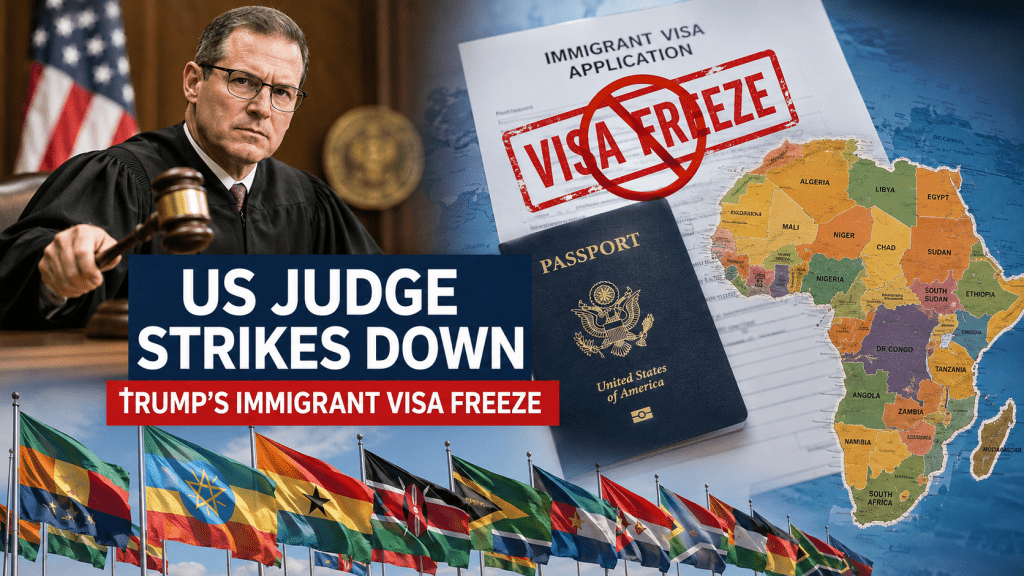
The ruling has particular significance for Africa. The State Department’s list included 26 countries on the continent, among them Nigeria, Ghana, Egypt and Morocco, leaving thousands of prospective immigrants and their American relatives facing uncertainty over whether their applications could proceed.
The suspension was introduced as part of the Trump administration’s wider effort to tighten legal immigration. The State Department argued that applicants from the affected countries presented a greater risk of becoming dependent on public assistance after arriving in the United States. Under American immigration law, consular officials can already consider whether an individual is likely to become what is legally known as a “public charge” when assessing an application.
The dispute centered on how that assessment should be made. Rather than allowing consular officers to evaluate applicants individually, the January policy effectively prevented immigrant visas from being issued to nationals of the designated countries as a group. Judge Vargas concluded that such a broad approach went beyond the authority Congress had given the secretary of state.
The judge also emphasized that federal immigration law contains protections against nationality-based discrimination in the issuance of immigrant visas. She found that the government could not automatically reject otherwise eligible applicants solely because they held passports from countries included on the State Department’s list.
The decision goes beyond stopping the policy from being applied to new cases. Vargas also set aside visa refusals that had been issued solely because of the suspension, potentially allowing affected applicants to have their cases reconsidered under the ordinary immigration process.
That could be particularly important for families separated by the freeze. The lawsuit challenging the policy was brought by immigrant-rights organizations, including African Communities Together and the Catholic Legal Immigration Network, alongside individual visa applicants and U.S. citizens sponsoring relatives abroad. Some of the plaintiffs had family members in African countries, including Ghana and Ethiopia, whose immigration cases were affected.
The ruling does not mean applicants from the affected countries will automatically receive visas. Each person must still satisfy existing U.S. immigration requirements, undergo security and background checks and demonstrate eligibility under the law. Consular officers also retain authority to reject applicants on established legal grounds, including individual public-charge concerns where applicable.
The decision instead restores individualized assessment. For African applicants, that distinction means nationality alone can no longer serve as the basis for rejection under the policy that the court has now overturned.
The suspension applied specifically to immigrant visas, which are generally used by people intending to settle permanently in the United States through family or employment pathways. It did not apply in the same way to temporary nonimmigrant visas, such as those used by tourists and international students.
The case is part of a broader legal battle over the Trump administration’s immigration agenda. President Donald Trump has pursued tighter immigration and border policies since returning to office, arguing that stronger restrictions are necessary to protect national security and limit the potential burden on public resources. Immigration advocates have challenged several measures, arguing that the administration has exceeded powers granted under federal law.
The latest ruling does not necessarily bring the dispute to an end. The administration could appeal the decision to the U.S. Court of Appeals for the Second Circuit, meaning further legal proceedings could determine how the policy develops. The State Department said following the ruling that the administration remained committed to rigorous screening and vetting but would not comment further on pending litigation.
For applicants across the affected African countries, however, the immediate significance is substantial. The court has removed a restriction that prevented individual applications from being considered on their own merits and has created a pathway for cases rejected solely under the freeze to be reconsidered.
More broadly, the ruling reinforces the importance of Africa-U.S. migration links at a time when African professionals, entrepreneurs and families are increasingly connected to the American economy and diaspora. While immigration requirements remain stringent, the decision restores an established legal route for qualifying applicants from the affected countries.
For thousands of families and prospective immigrants, the ruling therefore represents more than a legal judgment. It restores the possibility that their applications can once again be evaluated individually, based on their circumstances and eligibility rather than simply the country named on their passport.
