
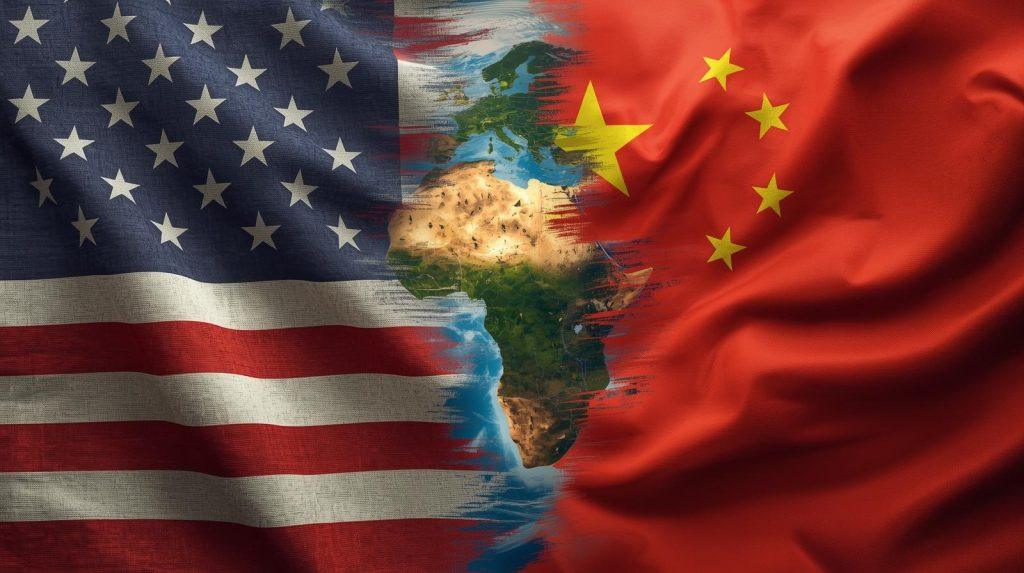
Recent data suggests the landscape is shifting. According to the China Africa Research Initiative at Johns Hopkins University, the United States invested $7.8 billion in Africa last year—nearly double China’s $4 billion. It is the first time since 2012 that the U.S. has surpassed China as the continent’s largest source of foreign direct investment.
Much of this surge is being driven by the U.S. International Development Finance Corporation, or DFC, a government agency created in 2019 during the Trump administration. Its mission statement leaves little ambiguity: It aims to counter China’s growing influence in strategic regions, Africa chief among them.
New Money, New Leverage
In Rwanda, Trinity Metals—a company that mines tin, tantalum and tungsten—secured a $3.9 million DFC grant last year. The firm now ships Rwandan tungsten to a processing facility in Pennsylvania and has a new agreement to send tin to another U.S. smelter.
Shawn McCormick, the company’s chairman, insists Washington did not pressure the company to route minerals to the United States.
“It’s our own commercial decision,” he says. Trinity, partly owned by Rwanda’s government and the Irish firm TechMet, emphasizes that it adheres to strict environmental and labor standards—contrasting itself with operations that rely on untrained laborers in hazardous conditions.
But not everyone in Africa sees rising U.S. investment as a clear-cut victory.
African Governments Seek a Stronger Voice
Economist Sepo Haihambo, a former executive at FNB Namibia, argues that African nations must guard their interests and avoid assuming American negotiators will prioritize African development.
“To expect U.S. officials to propose terms that automatically favor Africa would be unrealistic,” she says.
She urges African governments to move beyond simple “cash-for-minerals” models and instead pursue production-sharing agreements, joint ventures, or local equity arrangements. Such structures, she argues, could feed into national sovereign wealth funds—bolstering education, healthcare and long-term development.
Haihambo also believes African states should expand mineral processing at home rather than exporting raw materials. Keeping more of the value chain on the continent could generate skilled jobs and stronger local economies.
Refining on the Continent
Some American firms are taking that approach. In South Africa’s Gauteng province, ReElement Africa—a subsidiary of U.S.-based American Resources—is building a refinery for critical minerals.
Ben Kincaid, the subsidiary’s CEO, says the goal is to bring value-added processing closer to mine sites:
“You can build an economy around these zones and lay the foundation for future industrial development.”
A Missed Opportunity—and a Competitive Future
Lee Branstetter, an international economist at Carnegie Mellon University, argues that tariffs imposed under the Trump administration dampened enthusiasm for U.S. engagement at a time when some African communities were already questioning the local benefits of Chinese projects.
“If those tariffs had not been applied so broadly and with so little explanation,” he says, “the U.S. would likely be better positioned to capitalize on African frustrations with Chinese investment.”
And the race is not limited to the world’s two largest economies. Countries such as Brazil, India and Japan are showing heightened interest in Africa’s resources—setting the stage for a more complex, multipolar competition.
