
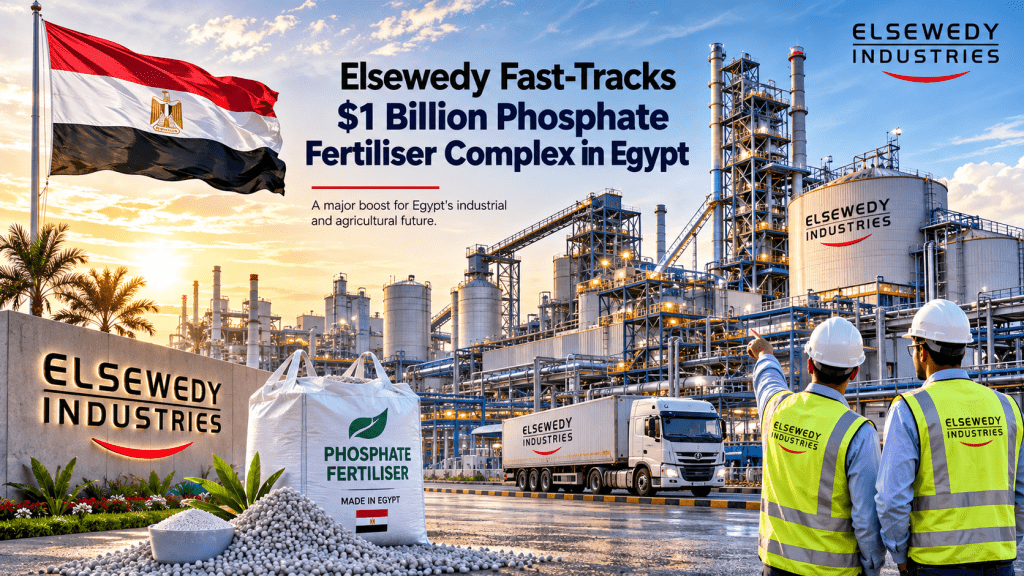
The integrated complex will be developed in Ain Sokhna within the Suez Canal Economic Zone, giving it a strategic position close to one of the world’s busiest maritime trade corridors. The location could allow producers to serve domestic demand while reaching customers across Africa, Europe, Asia and the Middle East with comparatively efficient access to international shipping routes.
The project brings together Elsewedy Capital, Egypt’s Mineral Resources and Mining Industries Authority and the New Valley Company for Mineral Resources and Oil Clay, known as WadiCo. The three partners signed a shareholders’ agreement in July to establish the company responsible for developing, constructing, managing and operating the complex.
Development is planned in three phases, with total investment estimated at $1 billion. The first stage is expected to produce about 300,000 tonnes of phosphoric acid annually, alongside roughly 300,000 tonnes of phosphate fertilisers, including diammonium phosphate and triple superphosphate.
The later phases will move Egypt further up the industrial value chain. Between 2029 and 2031, the project is expected to expand into high-purity phosphoric acid and specialized phosphate chemicals. A third stage, planned between 2032 and 2034, would extend production into materials used in electric batteries, linking Egypt’s mineral industry with the rapidly expanding global clean-technology economy.
For Egypt, the project represents a broader shift in how the country intends to use its natural resources. Rather than relying heavily on exports of unprocessed phosphate rock, the government wants more of the mineral to be converted domestically into fertilisers, chemicals and advanced industrial products that command greater value in international markets. The Petroleum Ministry has identified this transition toward value-added mining as a central part of its strategy.
Egypt has considerable resources to support that ambition. The country holds an estimated 2.8 billion tonnes of phosphate reserves, according to figures previously presented by the Petroleum Ministry, giving it a strong foundation for developing a larger domestic processing industry.
Expanding fertiliser production could also strengthen agricultural resilience. Fertilisers are essential to maintaining crop yields and food production, but international markets have faced repeated disruptions in recent years. Restrictions affecting Chinese fertiliser exports and instability around major Middle Eastern supply routes have added pressure to global availability, increasing the importance of alternative production centers.
Egypt’s location gives it a potential advantage. A large fertiliser industry positioned near the Suez Canal could supply markets across Africa while also serving buyers in Europe and Asia. That geographic reach could help the country build a larger export industry around resources that were previously shipped abroad with limited processing.
The Ain Sokhna development also forms part of a wider expansion of Egypt’s phosphate-processing industry. The government has been advancing additional projects designed to convert domestic phosphate ore into phosphoric acid, fertilisers and other higher-value products through partnerships with Egyptian and international investors.
Those investments could generate benefits beyond mining itself. Large chemical and fertiliser complexes require engineers, technicians, logistics providers and supporting manufacturers, creating opportunities for skilled employment and local supply chains. They can also encourage technology transfer and develop expertise that can support other parts of Egypt’s industrial economy.
The project ultimately illustrates Egypt’s broader ambition to move beyond being primarily a supplier of raw minerals. By processing phosphate domestically and expanding eventually into specialized chemicals and battery materials, the country is seeking to capture a larger share of the value generated from its natural resources.
If the development proceeds as planned, Ain Sokhna could become an important new center for fertiliser and chemical production along the Suez Canal. More broadly, the $1 billion investment could strengthen Egypt’s role in global agricultural supply chains while demonstrating how African mineral resources can support manufacturing, exports and more diversified industrial growth.
