
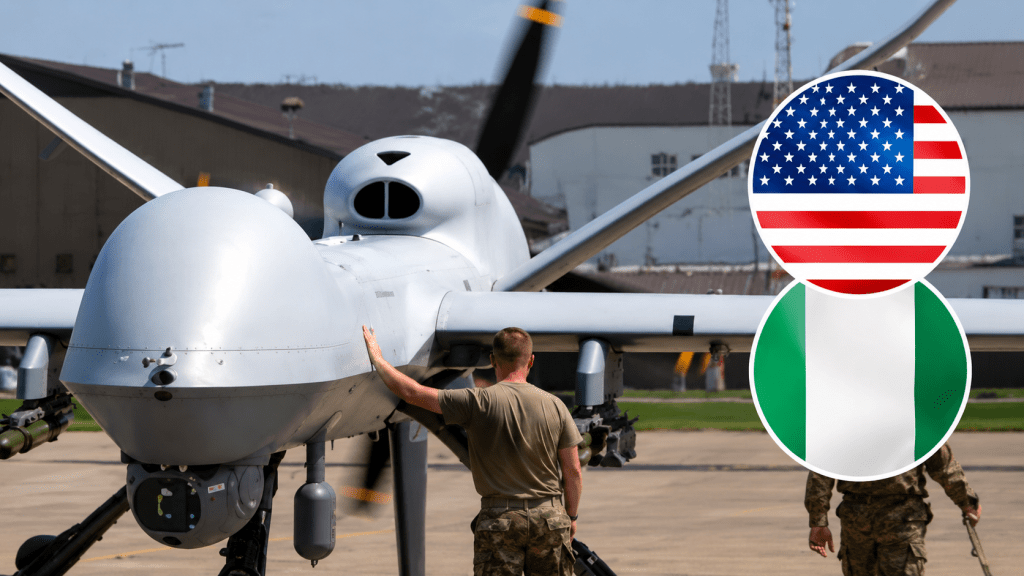
Unmanned aerial systems, commonly known as drones, have become an increasingly important part of modern military operations. They can provide forces with real-time surveillance and intelligence over areas that may be difficult or dangerous to reach on the ground, allowing commanders to improve situational awareness and make better-informed operational decisions.
At Bauchi, U.S. Army personnel trained members of the Nigerian Air Force Special Forces Regiment in the operation and use of small unmanned aircraft systems. The programme combined classroom instruction with practical experience, allowing Nigerian personnel to familiarize themselves directly with the technology.
The session was led by U.S. Army Sgt. Mark Murphy, an intelligence analyst with the 13th Combat Sustainment Support Battalion. About 10 Nigerian Air Force Special Forces personnel participated, beginning with roughly 45 minutes of instruction before moving to hands-on operation of the aircraft.
Beyond learning how to control the drones, Nigerian personnel were introduced to ways information gathered by unmanned aircraft can be incorporated into wider military operations. That capability can help forces monitor terrain, identify potential threats and provide commanders with additional intelligence before personnel are deployed into potentially dangerous environments.
The drone instruction forms part of a much broader training programme between the two countries. American and Nigerian forces have also worked together on tactical combat casualty care, combat lifesaving, weapons familiarization, camouflage, water treatment and testing, explosive ordnance disposal and small-unit tactics.
Those programmes reflect an increasingly practical approach to military cooperation. Rather than focusing solely on major equipment purchases, the partnership is also emphasizing training and technical expertise that can strengthen the ability of Nigerian personnel to operate effectively with existing and emerging technologies.
The latest programme follows Nigeria’s participation in African Lion 2026, the U.S.-led multinational military exercise held across Morocco, Ghana, Senegal and Tunisia earlier this year. More than 5,600 military and civilian personnel from over 40 countries participated in the wider exercise, which included training on small unmanned aircraft and counter-drone capabilities.
More than 20 service members from four countries participated in the inaugural drone academics programme held in Morocco during African Lion. Nigeria was among the countries involved, making the Bauchi training part of a wider effort to build familiarity with unmanned technologies among African security partners.
The growing emphasis on drones reflects changes taking place across modern warfare. Relatively small unmanned systems can provide surveillance and intelligence at significantly lower operating costs than conventional aircraft, while counter-drone technologies have become increasingly important as armed groups and conventional militaries expand their own use of unmanned platforms.
For Nigeria, those capabilities are particularly relevant as its armed forces continue confronting Islamist militants and other armed groups. Security operations in the northeast have required forces to operate across large and sometimes difficult terrain, making intelligence, surveillance and reconnaissance capabilities an important part of efforts to locate and respond to threats.
The United States has expanded its involvement in those efforts. In March, the U.S. deployed MQ-9 Reaper drones and about 200 personnel to Nigeria, increasing Washington’s intelligence and training role in the country’s campaign against Islamist militants.
That cooperation has also extended into coordinated operations. In May, U.S. Africa Command said it conducted operations against ISIS targets in northeastern Nigeria in coordination with the Nigerian government. AFRICOM said an operation on May 16 killed a senior ISIS figure, with additional coordinated strikes taking place the following day.
The expanding relationship places Nigeria within a wider U.S. security strategy in Africa. Washington maintains military partnerships across East Africa, North Africa and parts of the Sahel through exercises, professional exchanges, intelligence cooperation and specialized training intended to strengthen the ability of national forces to address regional threats.
For Nigeria, the partnership offers access not only to military equipment but also to expertise in areas that are becoming increasingly important to modern defense. Building local proficiency in unmanned systems could allow Nigerian forces to integrate drones more effectively into surveillance, reconnaissance and other operations while developing personnel capable of training others domestically.
The cooperation could also improve interoperability between Nigerian and American forces. Shared training procedures and greater familiarity with technology can make it easier for the two militaries to exchange intelligence, participate in multinational exercises and coordinate when responding to common security threats.
U.S. Africa Command says further training opportunities are already being developed at Bauchi, suggesting that the latest programme is intended to be part of a continuing partnership rather than a standalone exercise.
As drone technology becomes more important to military operations worldwide, Nigeria’s expanding cooperation with the United States could help accelerate the modernization of its security capabilities. The partnership is increasingly moving beyond conventional training toward technology, intelligence and specialized expertise, areas likely to play a growing role in how Africa’s largest country responds to evolving security challenges.
