
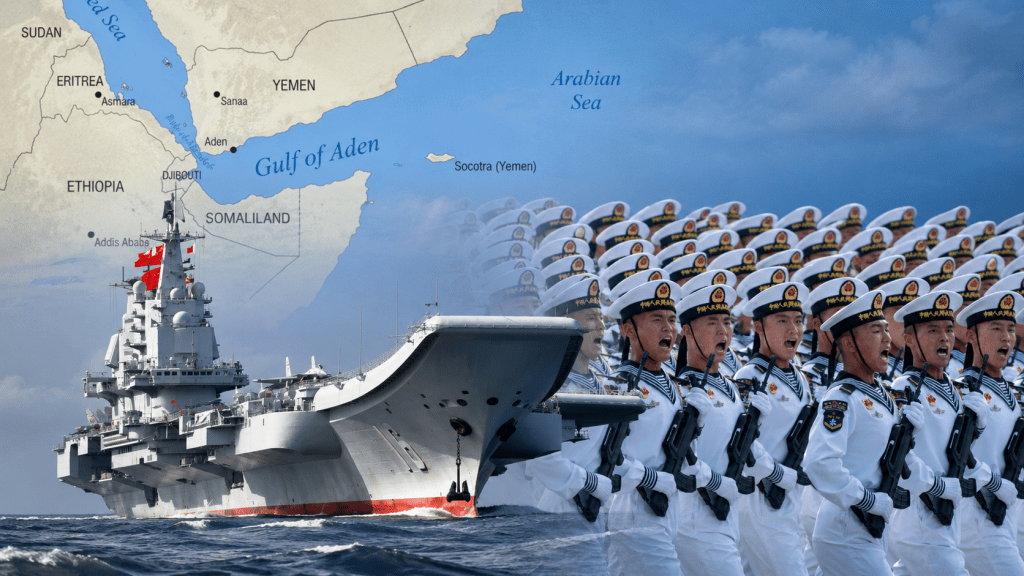
The fleet will replace China’s previous escort formation in the region, continuing a naval presence that Beijing has maintained off the Horn of Africa since 2008. Those missions were initially established in response to widespread attacks on commercial vessels by Somali pirates and have since become one of China’s longest-running overseas naval operations.
For China, maintaining security along the route has significant economic importance. The Gulf of Aden provides access between the Indian Ocean and the Red Sea, which leads through the Suez Canal to the Mediterranean. The corridor connects Asian manufacturing centers with markets in Europe and Africa and remains vital to global energy and merchandise trade.
China’s continued presence also reflects the growing international importance of maritime security around the Horn of Africa. Commercial vessels travelling through the region have faced a combination of piracy, armed attacks and wider geopolitical tensions, increasing pressure on governments to strengthen protection for shipping crews and cargo.
Africa Builds Its Own Maritime Response
At the same time, African and regional governments are moving toward a more coordinated security framework of their own. Signatories to the Djibouti Code of Conduct and its Jeddah Amendment have agreed to establish a Combined DCoC Task Force aimed at coordinating operations against piracy and armed robbery at sea.
The initiative represents an important shift toward greater regional responsibility for maritime security. Instead of depending predominantly on foreign naval deployments, participating states would have a mechanism through which they can coordinate operations, exchange information and respond collectively to threats affecting their territorial waters and nearby international shipping routes.
The proposed force was announced after participating governments agreed that renewed piracy in the Western Indian Ocean and Gulf of Aden required a stronger collective response. The task force is intended to complement rather than replace existing international maritime-security operations.
That cooperation could prove particularly important because maritime threats rarely remain within national boundaries. Pirates and other armed groups can move between territorial waters and international shipping lanes, making coordination among neighboring countries essential to effective enforcement.
The Djibouti Code of Conduct was adopted in 2009 primarily as a regional response to piracy and armed robbery in the western Indian Ocean and Gulf of Aden. Its scope was expanded through the 2017 Jeddah Amendment to address a wider range of maritime crimes and security challenges.
The framework includes countries along the eastern and southern African coastline as well as states around the Arabian Peninsula and western Indian Ocean. By pooling surveillance, intelligence and operational capabilities, participating countries can potentially respond more quickly to suspicious activity while building stronger domestic maritime institutions.
Piracy Returns to the Regional Agenda
The renewed focus follows signs that piracy has not disappeared from waters around Somalia. Although international naval operations and stronger security measures dramatically reduced attacks from their peak more than a decade ago, recent incidents have demonstrated that armed groups retain the ability to target commercial vessels.
That resurgence carries economic implications extending far beyond Somalia. Shipping companies facing greater security risks may increase insurance premiums, employ private security personnel or reroute vessels. Those additional expenses can ultimately raise the cost of transporting fuel, food and manufactured goods between Africa, Asia and Europe.
For African economies dependent on maritime trade, safer shipping lanes therefore have direct economic value. Ports from Djibouti and Mombasa to Dar es Salaam and Durban form part of commercial networks connecting landlocked African economies with international markets. Protecting the wider Indian Ocean corridor helps preserve those supply chains.
The security challenge has become even more important because the Red Sea and Gulf of Aden have faced wider instability in recent years. Disruptions have forced some commercial vessels to avoid the Suez route and sail around the Cape of Good Hope instead, adding considerable time and expense to journeys between Asia and Europe.
A stronger African-led maritime security architecture could consequently serve both regional and global interests. Countries along the coastline have the geographic knowledge and long-term interest required to patrol these waters, while international partners can provide technology, training and additional naval capacity.
China Maintains a Long-Term Presence
China’s latest deployment demonstrates Beijing’s continuing commitment to that international effort. Since beginning anti-piracy escort operations in December 2008, Chinese naval fleets have regularly rotated through the Gulf of Aden and waters around Somalia, protecting commercial shipping and participating in wider maritime-security activities.
The operations have also provided China’s navy with extensive experience conducting long-distance missions far beyond its home waters. Maintaining ships, helicopters and hundreds of personnel thousands of miles from China requires sophisticated logistics, replenishment and command capabilities.
The presence of the supply ship Luomahu in the latest deployment illustrates the importance of those logistics. Supply vessels allow naval forces to remain at sea for extended periods by providing fuel, food and other necessities to accompanying warships.
For African countries, international naval deployments can provide valuable additional capacity while regional governments continue developing their own capabilities. The emerging DCoC task force could create a framework through which those international efforts increasingly operate alongside stronger African-led security structures.
The goal is ultimately not simply to deploy more warships, but to create waters where commercial vessels can travel safely without requiring constant military protection. Achieving that will require intelligence sharing, effective coastal policing, stronger judicial systems and economic development alongside naval patrols.
The combination of China’s continuing deployment and Africa’s planned regional task force shows how maritime security around the Horn of Africa is evolving. International powers remain deeply involved, but African governments are increasingly seeking to coordinate and lead their own response.
For a region positioned beside one of the world’s most valuable trade corridors, that growing cooperation could carry substantial economic benefits. Safer seas protect sailors and cargo, but they also protect the trade flows, ports and supply chains on which economies across Africa and the wider world depend.
