
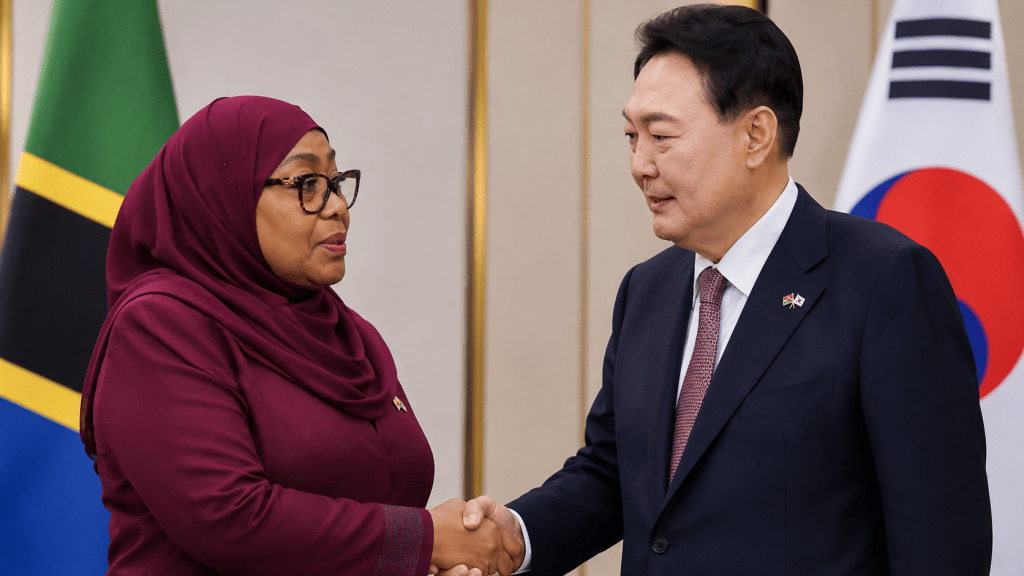
The planned institute will train students and professionals in artificial intelligence, robotics, data analytics and Internet of Things technologies. South Korean financing will support the construction of classrooms, laboratories and other campus facilities while providing the equipment required to deliver advanced technical education.
The facility is expected to include dedicated AI laboratories, robotics equipment, drones, 3D printers, IoT systems and broader information and communications technology infrastructure. The project will also support curriculum development, computer networks and the operation and maintenance of the institution.
For Tanzania, the investment comes as artificial intelligence is beginning to reshape industries around the world. Building domestic expertise could allow the country to participate more actively in that transformation rather than relying predominantly on imported technology and foreign specialists.
The institute is expected to expand Tanzania’s pool of engineers, data specialists and other technology professionals. Those skills could eventually be applied across industries including banking, agriculture, manufacturing, telecommunications and public services, giving the project an economic reach that extends well beyond the technology sector itself.
Agriculture, for example, could benefit from greater use of data analytics, automated systems and digital monitoring. Financial institutions could expand AI-powered services, while manufacturers could adopt robotics and smarter production systems. Government agencies could also use digital tools to improve the delivery of public services.
The project fits closely with Tanzania’s long-term development ambitions. Under Vision 2050, the government wants the country to become an industrialized, knowledge-based and upper-middle-income economy, targeting annual economic output of about $1 trillion and per capita income of $7,000 by the middle of the century.
Technology and human capital will be central to achieving that goal. Tanzania’s economy is projected at about $94.9 billion in 2026, placing it among East Africa’s largest. Building a larger base of highly skilled workers could help the country attract investment into higher-value industries while creating new opportunities for young people entering the labor market.
The South Korean investment arrives as Tanzania intensifies a broader campaign to attract international capital. In June, the country hosted an investment summit in Arusha focused on mobilizing financing for infrastructure, energy, tourism and other industries. The government has also identified 68 priority public-sector projects valued at roughly $6.57 billion, covering roads, ports, water, energy, tourism and industrial development.
Investment registrations have already risen sharply. Tanzania recorded 915 projects valued at $10.95 billion in 2025, compared with 252 projects worth $3.7 billion in 2021, according to figures from the Tanzania Investment and Special Economic Zones Authority cited by Business Insider Africa. Authorities have also introduced a one-stop system intended to simplify approvals for investors.
That momentum has continued despite political tensions following Tanzania’s disputed October 2025 election. The United States said later that year that it was reviewing aspects of its relationship with Tanzania, citing concerns about post-election violence, restrictions on political activity and obstacles facing American investors. President Samia Suluhu Hassan’s government has nevertheless continued seeking capital from partners across Africa, Asia and other international markets.
South Korea’s involvement gives Tanzania another major Asian development partner at a time when competition for Africa’s technology market is increasing. China has already built a substantial presence in African telecommunications and digital infrastructure, while American and European companies are expanding investments in cloud computing, artificial intelligence, fintech and data centers.
For South Korea, the project creates an opportunity to bring its technological expertise into that increasingly competitive market. South Korean AI, education technology and ICT companies could use the partnership to establish relationships in Tanzania before expanding into neighboring economies and the wider continent.
South Korea brings considerable experience to the partnership. Its transformation from a developing economy into a global leader in electronics, telecommunications, semiconductors and advanced manufacturing has been closely linked to investment in education, research and technological capability. Applying elements of that experience in Tanzania could strengthen the project beyond the physical construction of laboratories and classrooms.
The long-term value of the investment will therefore depend largely on the skills it creates. Training Tanzanian engineers, researchers and entrepreneurs could encourage the development of locally designed technologies that respond directly to African challenges rather than simply importing solutions created elsewhere.
The $170 million investment ultimately represents more than the construction of another educational institution. It places artificial intelligence at the center of a new economic partnership between South Korea and Tanzania while giving the East African country an opportunity to build the workforce needed for an increasingly digital global economy.
If successfully implemented, the institute could become a foundation for a broader technology ecosystem linking education, research, entrepreneurship and international investment. For Tanzania, that would bring its Vision 2050 ambitions another step closer while positioning the country to participate more strongly in Africa’s emerging AI economy.
