
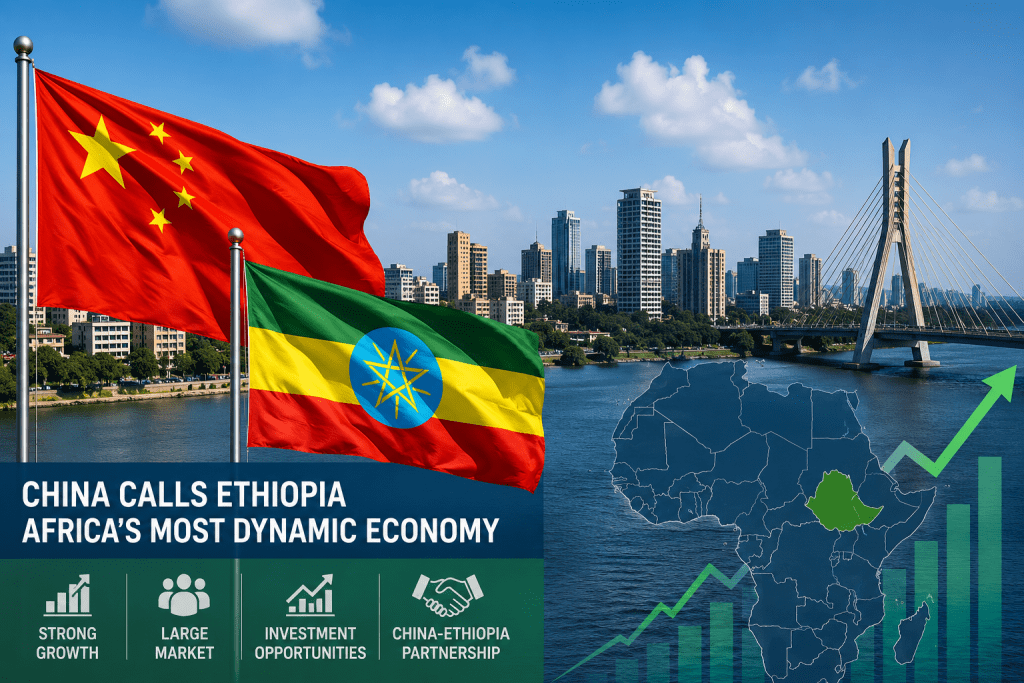
A central part of the expanding relationship is China’s decision to provide zero-tariff treatment for Ethiopian exports. Beijing has coupled the policy with trade-facilitation measures intended to lower the cost of entering the Chinese market, particularly for small and medium-sized Ethiopian businesses.
The arrangement could give Ethiopian producers greater access to China’s enormous consumer market while encouraging companies to improve the quality and competitiveness of their products. For Ethiopia, the opportunity extends across agriculture, manufacturing and other industries where increased exports could generate foreign exchange and support employment.
Chen said the measures are intended to transform preferential trade arrangements into practical commercial opportunities for Ethiopian companies. Lower barriers could make it easier for exporters to establish relationships with Chinese buyers while creating incentives for Chinese and other international investors to expand operations in Ethiopia’s most competitive industries.
The emphasis on exports comes as Ethiopia pursues a broader strategy of industrialization and agricultural modernization. The country has spent years investing in industrial parks, energy projects, transportation networks and manufacturing capacity, seeking to shift gradually from an economy dominated by primary commodities toward one that produces more processed and manufactured goods.
Improved access to China could support that transition. Instead of exporting mainly raw agricultural products and commodities, Ethiopian businesses have an opportunity to develop higher-value goods that can compete in international markets. Greater processing at home would allow the country to retain more of the economic value generated from its resources while supporting manufacturing and skilled employment.
China’s economic presence in Ethiopia already extends far beyond conventional trade. Chinese companies have played a major role in building roads, railways, industrial facilities and other infrastructure across the country, establishing Ethiopia as one of Beijing’s most important economic partners in East Africa.
That relationship is now visible in one of Ethiopia’s most ambitious infrastructure developments: the $12.5 billion Bishoftu International Airport. Chinese companies have emerged as leading contenders for major construction contracts on the project, which is intended to significantly expand Ethiopia’s aviation capacity and reinforce Addis Ababa’s position as one of Africa’s leading international transport hubs.
The competition for the airport has attracted companies and joint ventures from China, Europe, the Middle East, Türkiye, India and Russia. Chinese companies secured 15 of the 33 positions across the shortlisted groups following prequalification for four major construction packages, giving them a strong position as Ethiopia prepares to award contracts.
Among the Chinese companies involved are Beijing Urban Construction Group, China Communications Construction Company, China Road and Bridge Corporation and China Civil Engineering Construction Corporation. The contracts cover the main passenger terminal and airport buildings, airfield construction, supporting infrastructure and transport connections outside the airport.
The scale of the Bishoftu project illustrates why Ethiopia is attracting increasing attention from international investors. Designed ultimately to handle as many as 110 million passengers annually, the airport is intended to provide Ethiopian Airlines with the capacity needed to continue its international expansion while creating a major new aviation and logistics center for the continent.
China and Ethiopia are also exploring closer financial cooperation. Ethiopia has held discussions with Beijing about converting part of its dollar-denominated debt to Chinese yuan. The country owes China about $5.38 billion, and Ethiopian officials have considered whether changing the currency structure of some obligations could help manage repayment pressures.
The discussions demonstrate how the relationship between the two countries has evolved from infrastructure financing into a much broader economic partnership encompassing trade, investment, industrial development and financial cooperation.
Both countries are also members of the expanded BRICS grouping, providing another platform for cooperation on international economic and trade issues. Ethiopian and Chinese officials have emphasized greater coordination within multilateral institutions as emerging economies seek a stronger role in shaping global commerce.
For Ethiopia, stronger ties with China arrive at an important stage of its economic transformation. The country has a large population, expanding infrastructure and substantial opportunities in agriculture, manufacturing, mining, energy, logistics and aviation. Reforms that make these industries more accessible to private and international investors could help unlock additional capital.
China’s description of Ethiopia as Africa’s most dynamic market therefore reflects more than diplomatic language. Zero-tariff access, growing infrastructure investment and stronger commercial ties are creating practical opportunities for Ethiopian businesses to reach one of the world’s largest markets.
If Ethiopia can translate that access into greater exports, manufacturing and investment, its partnership with China could become an important driver of the country’s next phase of economic development. More broadly, the relationship illustrates how Africa’s large emerging economies are increasingly using international partnerships not only to finance infrastructure, but also to expand industrial capacity and compete more effectively in global markets.
