
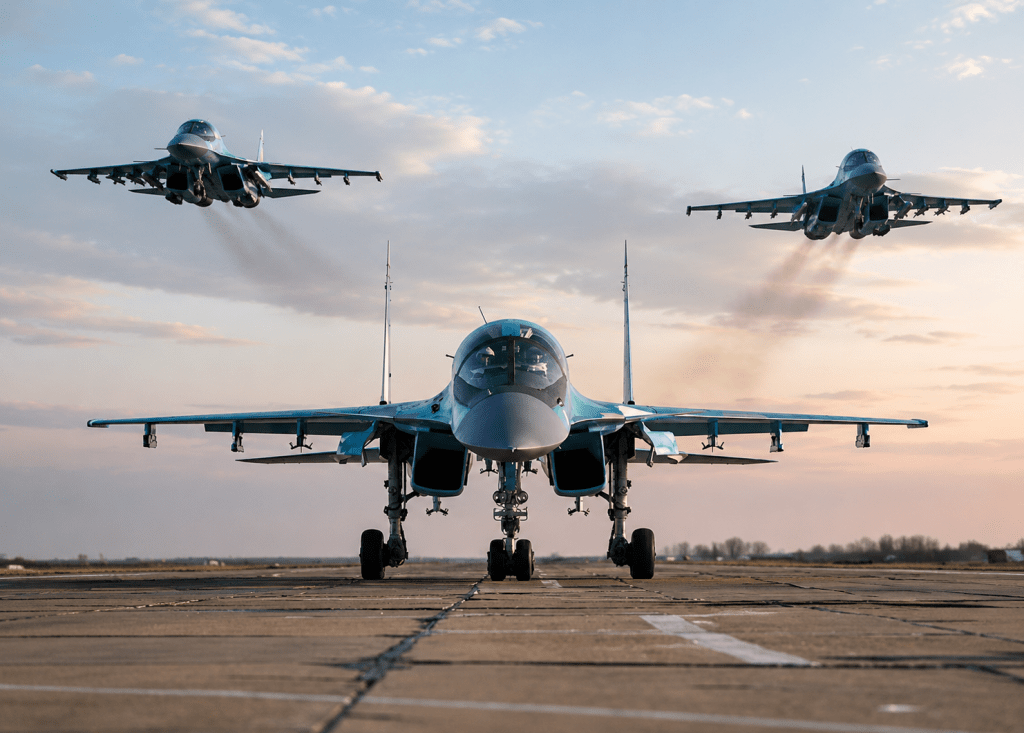
The aircraft’s appearance has added to that speculation. Its light desert-style paint scheme resembles markings associated with other aircraft linked to Algeria, including the Su-57E and Su-34. Claims circulating online had suggested that the tanker might instead be connected to a large Chinese order, but aviation observers and industry sources have questioned that interpretation.
For Algeria, additional aerial refueling capacity would complement a broader effort to build one of Africa’s most sophisticated air forces. Rather than focusing exclusively on fighter aircraft, the country has invested in the support systems needed to keep those aircraft operating farther from their bases and for longer periods.
The Il-78MK-90A is the latest export-oriented version of Russia’s Il-78 tanker family and is based on the modernized Il-76MD-90A transport aircraft. It is designed primarily to refuel military aircraft while they are airborne, allowing fighters and other compatible aircraft to substantially extend their range and endurance.
The tanker can transfer as much as 78 tonnes of fuel through three hose-and-drogue refueling units positioned beneath its wings and rear fuselage. It is powered by four PS-90A-76 engines and can also perform additional roles, including transporting cargo and supporting medical evacuation operations.
Those capabilities could be particularly valuable as Algeria introduces more advanced combat aircraft. The country has been identified as the first export customer for Russia’s Su-57 stealth fighter, and Russian officials said in November 2025 that the first two Su-57s destined for a foreign customer had entered service, although they did not publicly name the recipient. Algeria has also been linked to an eventual fleet of roughly a dozen Su-57Es.
The new aircraft would join an air force already built heavily around Russian and Soviet-designed platforms. Algeria operates Su-30MKA fighters, MiG-29 variants, Su-24 strike aircraft and existing Il-78 tankers, among other aircraft. That established ecosystem could make integrating a newer Il-78 variant easier than introducing an entirely different refueling platform.
Aerial refueling would give Algeria’s combat fleet greater flexibility. Fighters supported by tankers can conduct longer patrols, remain airborne during extended surveillance missions and operate over greater distances without relying as heavily on forward airfields. The capability therefore represents an important component of modern air power alongside fighters, surveillance aircraft and air-defense systems.
The possible acquisition also fits Russia’s broader strategy of offering international customers integrated defense packages rather than individual platforms. Moscow has promoted combinations of fighters, helicopters, drones, air-defense systems, armored vehicles and support aircraft, including the Il-78MK-90A.
For Algeria, that model aligns closely with its existing military structure. Decades of purchasing Russian equipment have produced a defense system in which combat aircraft, transport planes, missiles and air-defense platforms share common technological origins. The addition of newer support aircraft could allow Algeria to modernize that system while maintaining continuity in training, maintenance and operations.
Algeria’s substantial energy revenues have helped finance that modernization. The country allocated about $25.4 billion to defense, according to figures cited by Business Insider Africa, giving it the largest military budget on the continent and representing roughly 8.8 percent of gross domestic product.
The spending comes amid a broader modernization drive across North Africa. Algeria, Morocco and Egypt have all invested heavily in advanced aircraft, air defenses and other military technologies, increasing the strategic importance of sophisticated support capabilities such as aerial refueling.
For Algeria, the Il-78MK-90A would therefore represent more than another aircraft purchase. Combined with its new generation of fighters, additional tanker capacity could help transform the country’s air force from one centered largely on territorial defense into a force with greater endurance, flexibility and operational reach.
Although the customer for Russia’s newly unveiled tanker has yet to be officially confirmed, Algeria’s existing fleet, reported negotiations and continuing military investment make it a closely watched contender. If a deal is confirmed, it would mark another significant step in the country’s effort to build one of Africa’s most advanced and comprehensive air-power capabilities.
