
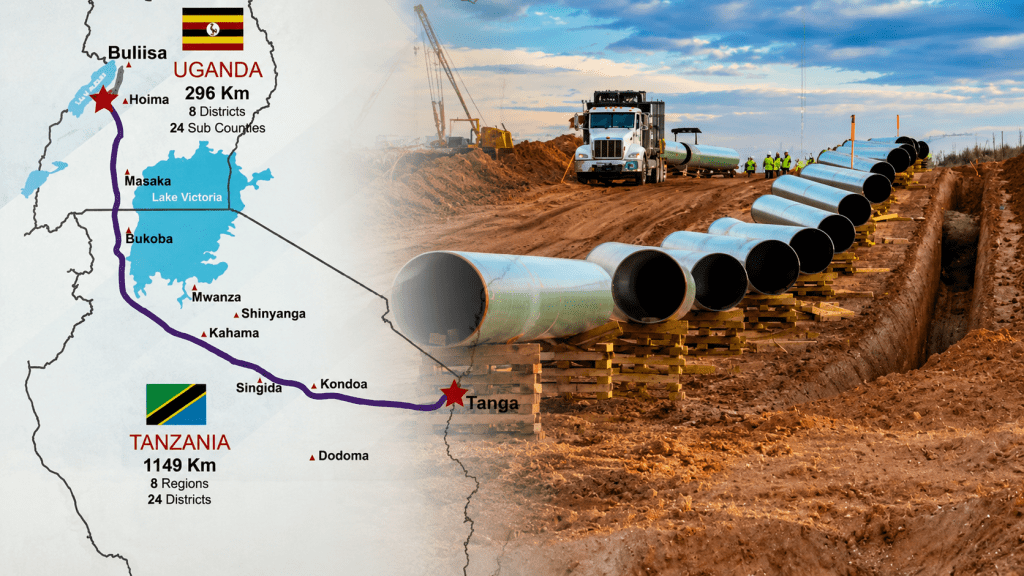
The project is particularly significant for Uganda, a landlocked country that requires access through neighboring Tanzania to commercially export its oil. EACOP effectively creates a direct energy corridor from Uganda to the sea, allowing the country to capitalize on petroleum discoveries that have been under development for years.
At approximately 897 miles, EACOP is designed to become the world’s longest electrically heated crude oil pipeline. Heating is necessary because Uganda’s crude is waxy and must be maintained at an elevated temperature to flow efficiently over the long journey from the Lake Albert region to the Tanzanian coast.
The pipeline is expected to transport as much as 216,000 barrels of crude oil a day, providing Uganda with the infrastructure required to establish itself as a new producer in international energy markets. Uganda has been preparing to begin commercial oil production, with the development of the pipeline advancing alongside production facilities at the country’s major oil fields.
For Tanzania, the project represents an important long-term economic opportunity even though the crude originates in Uganda. Tanzania hosts roughly 1,147 kilometers of the pipeline, giving it a central role in the project and creating opportunities around construction, logistics, transport and supporting services.
Tanzania is expected to generate about $3.5 billion in income from the project over 25 years once operations begin. The development is also projected to create more than 18,000 jobs over the same period, providing opportunities for workers and businesses along the pipeline corridor.
The project is being developed through a partnership involving Total Energies, CNOOC, the Uganda National Oil Company and the Tanzania Petroleum Development Corporation. The combination of international energy companies and national oil corporations reflects the scale of the investment and the importance both governments have placed on developing the region’s petroleum resources.
Beyond oil exports, EACOP could strengthen economic links between Uganda and Tanzania. The project requires cross-border infrastructure, logistics networks and coordinated energy policies, creating a new commercial corridor between Uganda’s western oil fields and Tanzania’s Indian Ocean coastline.
The investment is also contributing to wider economic activity in Uganda. Construction of the pipeline and related energy infrastructure has supported activity in sectors including construction and logistics, while the government expects future oil exports to provide an additional source of national revenue. Uganda’s economy expanded strongly in late 2025, with the Finance Ministry citing construction among the sectors supporting growth.
The project has nevertheless faced significant environmental, social, legal and financing concerns. Critics have raised questions about its impact on ecosystems and communities along the route, while supporters argue that oil revenues could provide Uganda with additional resources for infrastructure and economic development.
As construction approaches its final stages, the pipeline represents more than an export route. It could reshape the economic relationship between Uganda and Tanzania, giving a landlocked East African economy direct access to global energy markets while creating new investment, employment and infrastructure opportunities across the region.
For Uganda, the progress brings a decades-long ambition increasingly within reach: transforming its underground petroleum reserves into a commercially viable industry connected to the rest of the world.
