
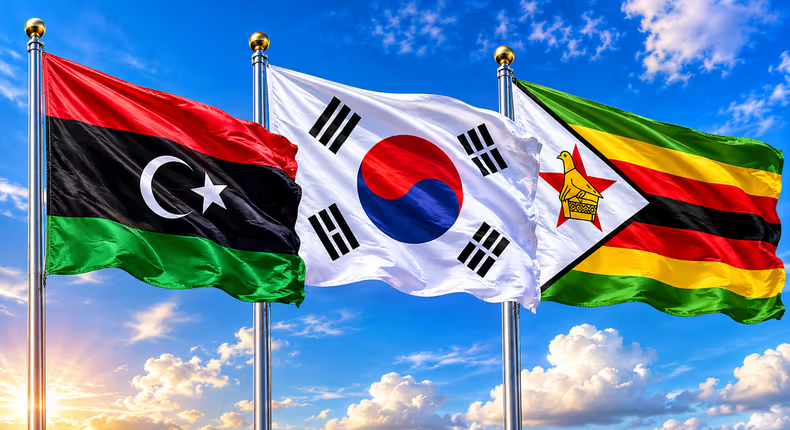
Recent discussions have focused on two sectors that are becoming increasingly important to the global economy.
In Libya, South Korean officials and energy companies are exploring opportunities tied to the country’s recovering oil industry. Despite years of political instability and conflict, Libya remains home to Africa’s largest proven oil reserves and has been working to increase production as international energy demand remains robust. South Korea, which imports nearly all of its crude oil requirements, sees Libya as a potential source of supply diversification at a time when instability in the Middle East continues to raise concerns about energy security.
At the same time, Zimbabwe has emerged as an increasingly important destination for South Korea’s critical minerals strategy.
The southern African nation possesses significant reserves of lithium, nickel, platinum and other minerals essential for electric vehicle batteries, semiconductors and renewable energy technologies. As one of the world’s leading producers of batteries and advanced electronics, South Korea faces mounting pressure to secure long-term access to these resources while reducing its dependence on a limited number of suppliers.
The growing interest in Africa is closely linked to South Korea’s industrial ambitions.
Companies such as Samsung, LG Energy Solution, SK On and POSCO occupy critical positions in global battery, semiconductor and advanced manufacturing supply chains. Their continued growth depends on reliable access to minerals including lithium, cobalt, graphite and rare earth elements, resources that Africa possesses in abundance. The continent is estimated to hold more than 30 percent of the world’s mineral reserves, including some of the largest deposits of minerals required for the global energy transition.
South Korea’s engagement with Africa has accelerated in recent years through a combination of diplomatic outreach, investment agreements and resource partnerships.
The inaugural Korea-Africa Summit in 2024 marked a significant milestone in those efforts, producing a series of agreements aimed at strengthening cooperation in mining, energy and industrial development. Since then, Korean institutions and corporations have expanded exploration, investment and development initiatives across several African countries.
Yet the strategy extends beyond resource acquisition.
African governments are increasingly demanding that foreign investment support local industrialization, processing capacity and economic development rather than simply facilitating the export of raw materials. Countries across the continent are pursuing policies designed to capture greater value from their natural resources through beneficiation and downstream manufacturing.
For South Korean investors, this means future partnerships are likely to require a more integrated approach, combining resource development with infrastructure, technology transfer and industrial investment.
The growing relationship also reflects Africa’s rising importance within the global economy.
As competition for energy resources and critical minerals intensifies among major powers, African countries are finding themselves at the center of strategic investment decisions involving the United States, China, Europe, the Gulf states and increasingly East Asian economies.
For South Korea, the continent represents both a source of strategic resources and a long-term economic partner.
For Africa, the growing interest highlights the continent’s expanding role in shaping the industries that will define the next generation of global growth, from electric vehicles and renewable energy to advanced manufacturing and digital technologies.
As the world transitions toward a more resource-intensive clean-energy economy, the connections being forged between Seoul, Tripoli and Harare may prove to be part of a much larger realignment of global supply chains and economic influence.
