
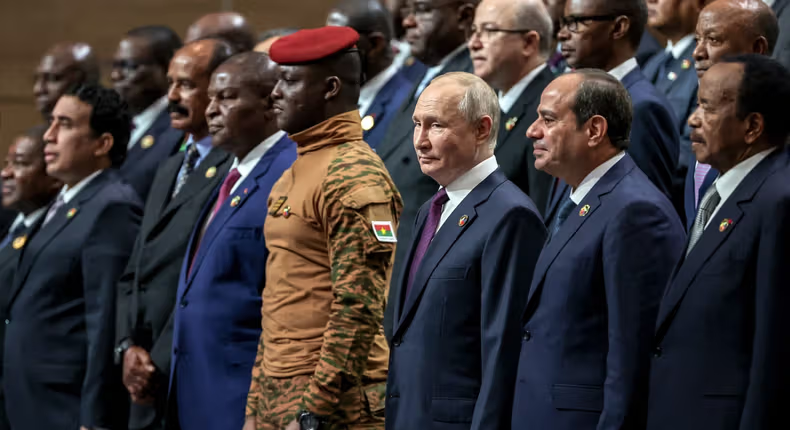
The announcement highlights how Africa has become an increasingly important arena for global strategic competition, with major powers seeking influence through defense partnerships, infrastructure investment, energy cooperation and resource access.
For Russia, military cooperation has emerged as one of the principal instruments of its engagement strategy.
Since facing Western sanctions following the annexation of Crimea in 2014, Moscow has steadily expanded diplomatic and security ties across Africa, positioning itself as an alternative security partner to Western governments. Reuters previously reported that Russia signed at least 19 military cooperation agreements with African countries between 2014 and 2018 alone, covering areas including military training, counterterrorism support and weapons supply.
The scale of Russia’s more recent defense activity suggests that strategy has accelerated significantly.
According to Rosoboronexport, the agreements span more than 40 African countries and include weapons systems, military equipment, technical support and training programs. Russian officials have increasingly framed the partnerships as part of a broader effort to support African sovereignty and security cooperation.
Africa’s expanding role within global defense markets reflects broader geopolitical shifts.
Governments across the continent continue to confront a range of security challenges, including insurgencies, terrorism, piracy and political instability, particularly across parts of the Sahel and Central Africa. Those conditions have increased demand for military equipment, intelligence cooperation and security partnerships from external powers.
Russia has become especially active in countries where Western military influence has declined in recent years.
In Mali, for example, Moscow significantly expanded its security role following the withdrawal of French and United Nations forces after successive military coups. Russian-backed security structures, including the Africa Corps, widely viewed as the successor to Wagner Group operations on the continent, have become increasingly involved in regional security operations.
At the same time, Russia’s growing military engagement has also strengthened its access to strategic economic interests, including mining concessions, energy investments and infrastructure partnerships in several African states. Analysts increasingly view Moscow’s security relationships as closely tied to broader geopolitical and commercial objectives.
The continent’s strategic importance has grown further amid rising global demand for critical minerals, energy resources and access to emerging markets.
Yet Russia is far from alone in expanding its footprint across Africa.
China, the United States, Turkey, the Gulf states and several European powers have all intensified economic and security engagement across the continent in recent years, reflecting Africa’s growing importance within global trade, supply chains and geopolitical competition.
The expansion of Russia’s defense relationships also comes during a period of sustained growth in global military expenditure. Worldwide defense spending reached record levels in recent years as geopolitical tensions and regional conflicts accelerated military procurement across multiple regions.
For African governments, the growing competition among external powers presents both opportunity and complexity.
Many countries are seeking to diversify strategic partnerships while leveraging international interest to strengthen domestic security capacity and economic development. At the same time, balancing relationships among competing global powers has become increasingly delicate as geopolitical rivalries intensify.
For Moscow, however, the message is increasingly clear.
At a time when Russia faces continued diplomatic and economic pressure from the West, Africa has emerged not only as a market for defense exports, but as a central pillar of the Kremlin’s broader strategy to expand influence across the Global South.
